How BBalance developed a new concept of “FIVE”
From the moment of its creation and until recently, kinesio tapes were used exclusively for the rehabilitation of athletes, so all manufacturers offered tapes with a standard level of fixation. Everything changed when taping began to be actively used in the field of aesthetics and clinical rehabilitation. Standard adhesive fixation no longer satisfied the variety of requests from new users and specialists, and most importantly, the standard adhesive base does not take into account the individual characteristics of the patient’s skin, conditions and duration of tape application.
BBalance does not stand still, constantly developing technology and products. The company’s history is a history of searching for the ideal solution for each client. Therefore, we were able to evolve the adhesive base of the tape for maximum comfort and effectiveness of kinesio taping. Let’s figure out what is special about the BBalance FIVE concept, and why it is so important to choose tapes taking into account the degree of adhesive fixation.
Universal tape for face and body — reality or advertising gimmick?
This approach does not take into account that our skin differs in density and sensitivity in different areas of the body. Moreover, taping can have completely different functions and features. For example, tape applied to the ankle should provide support for the joint for 5 days. While tape is applied to the face for a short period — from 2 to 10 hours. It turns out that if such a “universal tape” holds well on the ankle, then by sticking it to the face and neck area we get excessive fixation, as a result of which:
*the risk of a skin reaction on the face and neck increases sharply due to the high concentration of glue;
*the tape is much more difficult to remove — it is not only painful, but there is also a risk of damaging the skin when removing the tape.
And vice versa, if a “universal tape” with a weak adhesive base is suitable for aesthetic taping, then it is not suitable for fixing the ankle joint. Most likely, the tape will peel off within 1-2 days and will not perform its function.
Why is it important to choose tapes taking into account the degree of adhesive fixation?
The two main components of kinesio tape are elastic material and glue. And how securely the tape will be fixed to the body depends on the strength of the adhesive composition. At the same time, the components of any glue (even hypoallergenic) can cause a reaction on the skin – redness, itching or an allergic reaction with the appearance of blisters.
The better the glue fixes the tape on the skin, the higher its concentration and the higher the risk of skin reactions. It is important to take this pattern into account for the most comfortable use of kinesiology tapes.
A typical situation: when a skin reaction occurs, the user may think that kinesio taping is not suitable for his/her skin. And he/she refuses the technique, returning to using ineffective ointments or painkillers.
The problem is even more pressing in aesthetic taping. After all, the skin on the face and neck is even more sensitive to the components of the glue – the risk of skin reactions increases significantly. Thus, an incorrectly selected tape can forever discourage the desire to use taping for natural facial rejuvenation.
Revolutionary solutions in taping – the BBalance FIVE concept
Since the moment BBalance specialists began to actively introduce kinesiological tapes into clinical practice, various difficulties associated with skin reactions of patients have arisen in the process of working with various diagnoses. With frequent application of tapes to the same area of the body, the risk of skin irritations increased. Especially when working with children, the elderly, patients with thin and sensitive skin.
To solve this problem, the BB product line included the LITE series tapes for sensitive skin of the body. At that time, the main needs were covered – the range included tapes for working with the body with different levels of fixation.
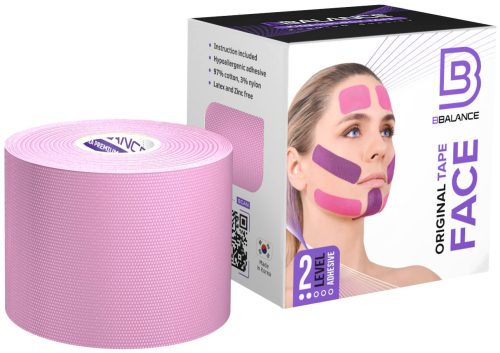
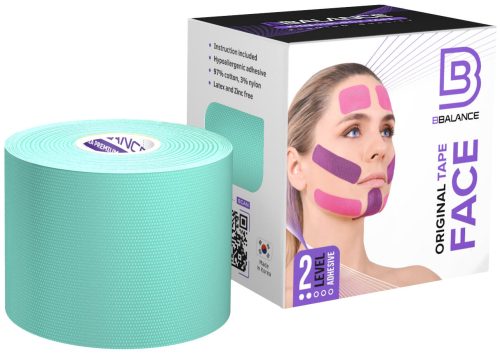
Universal tape: why does it not exist? How the BBalance company developed a new concept “FIVE” Photo-2 Similarly, when BBalance specialists were developing methods for aesthetic taping of the face, they again encountered a similar problem. The areas of the face and neck are the most sensitive, so the use of tapes for the body was often accompanied by skin reactions. And due to excessive fixation, removing them from the face was difficult and painful for patients.And only after numerous studies, the world’s first tape for aesthetic facial taping, BBalance FACE, was brought to market. As a result, the company created products with 3 levels of fixation for the body, and later developed 2 additional adhesive compositions with a softer base for facial taping.
When creating the BBalance FIVE concept, the company’s specialists set several goals:
► Dividing products into categories for more comfortable and effective use;
► Convenient classification to facilitate the selection of the most suitable product for different purposes and skin types;
► Significantly reducing the likelihood of skin reactions with frequent use;
► Facilitating the removal of tapes from particularly sensitive areas of the body.
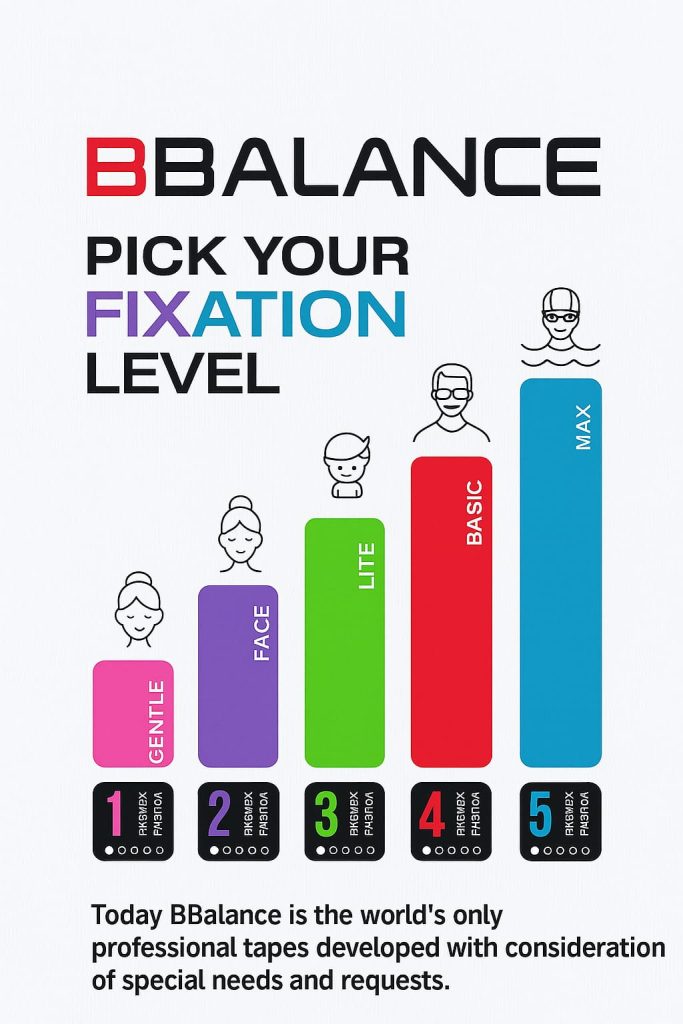
Today, BBalance is the only and one professional manufacturer in the world offering 5 levels of adhesive fixation of tapes, developed taking into account the characteristics of the skin and the purpose of the tapes:
GENTLE (level 1): super soft fixation
Particularly delicate fixation for particularly sensitive skin of the face and neck.
Recommended for overnight applications, minimizing the risk of skin reactions.
Ideal for beginners in aesthetic face taping, helping to understand the skin reaction.
Also suitable for body taping in sedentary elderly people with dry, easily injured skin.
FACE (level 2): soft fixation
Soft fixation for aesthetic taping of the face and neck.
Recommended for body taping in people with particularly sensitive skin and the elderly.
LITE (level 3): delicate fixation
Standard fixation for daily use and injury prevention.
Recommended for frequent applications on the same area of the body, such as fixing glucose monitoring sensors.
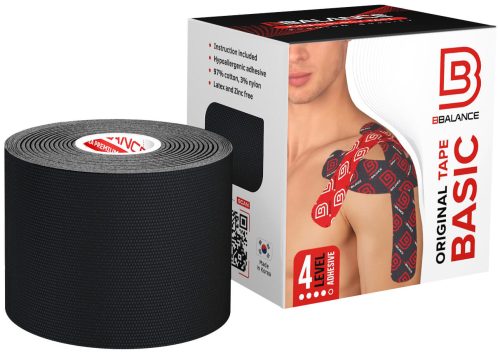
BASIC (level 4): standard fixation level
The most popular fixation level with a wide range of applications.
Ideal for people whose work involves constant physical exertion.
Can also be used to protect any part of the body from chafing.
MAX (level 5): enhanced fixation level
Maximum strong fixation for extreme conditions, such as water sports or high-intensity training.
Recommended for sports, in the pool, and for taping moving parts of the body, such as feet.